Table of Contents
- What Is Conversational Marketing?
- Conversational Marketing vs. Traditional Marketing
- The Core Channels of Conversational Marketing
- How to Implement Conversational Marketing: A Step-by-Step Framework
- Common Mistakes to Avoid in Conversational Marketing
- What's Next: Conversational Marketing Trends for 2026–2027
Your buyers expect quick answers. When customers have to wait too long for a response, they may lose interest or turn to competitors who offer faster support. Conversational marketing helps businesses engage prospects in real time, answer questions instantly, and turn more conversations into conversions.
What Is Conversational Marketing?
Conversational marketing is a customer engagement strategy that replaces one-way, broadcast-style communication with real-time, two-way dialogue. Instead of asking visitors to fill out a form and wait for a callback, you engage them instantly via live chat, AI-powered chatbots, and messaging apps like WhatsApp and Facebook Messenger.
Unlike traditional marketing funnels that force prospects through multiple processes (fill out a form, wait for an email, and schedule a call), conversational marketing compresses that journey into a single interaction. For instance, a visitor lands on your pricing page, asks a question, gets an answer from a chatbot, and books a demo all within two minutes.
The term “conversational marketing” was made up and popularized by Drift (which is now part of Salesloft), the company founded by David Cancel and Elias Torres. They believed that traditional B2B marketing was fundamentally broken for the modern buyer. Their book, Conversational Marketing, co-authored with Dave Gerhardt, helped establish the category.
Conversational Marketing vs. Traditional Marketing
Before deciding between conversational and traditional marketing, you have to understand both. Understanding the distinction helps clarify why this approach works:
| Feature | Traditional Marketing | Conversational Marketing |
| Communication | One-way (broadcast) | Two-way (dialogue) |
| Timing | Scheduled/delayed | Real-time / instant |
| Personalization | Segment-based | Individual-level |
| Channel type | Email, forms, ads | Chat, messaging apps, voice |
| Lead qualification | Manual (days/weeks) | Automated (minutes/seconds) |
| Availability | Business hours | 24/7 |
| Customer experience | Linear funnel | Fluid conversation |
You don’t have to choose one between conversational and traditional marketing. The strongest marketing strategies use traditional channels (content, SEO, paid ads) to drive awareness and conversational tools to capture and convert that attention in real time.
The Core Channels of Conversational Marketing
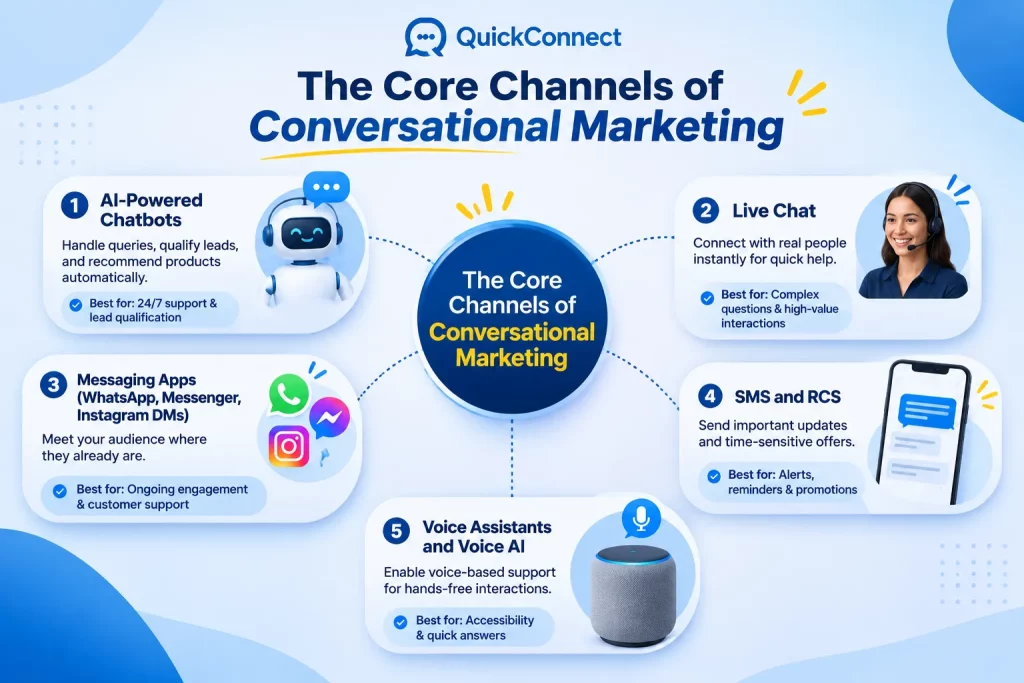
Conversational marketing operates across several key channels. The right mix depends on where your audience spends time and what stage of the buyer journey you are targeting.
Here are the core channels of conversational marketing:
1. AI-Powered Chatbots
Chatbots are one of the most important forms of conversational marketing. Modern AI chatbots powered by large language models and trained on your business data can handle complex queries, qualify leads, recommend products, and book meetings without human intervention.
However, not all chatbots offer the same capabilities. Learn about the key differences between chatbots and conversational AI to understand which technology best suits your business needs. These chatbots are best for 24/7 lead qualification, FAQ handling, product recommendations, and cart recovery.
2. Live Chat
Live chat connects visitors with real human agents in real time. Customers get instant answers to their queries. It is most effective for high-value interactions where nuance, empathy, or complex problem-solving is required.
3. Messaging Apps (WhatsApp, Messenger, Instagram DMs)
Messaging apps meet customers on platforms they already use daily. People use WhatsApp, Messenger, and Instagram every day, which makes it a powerful channel for businesses to connect with customers in markets. This channel is best for customer support, order updates, re-engagement campaigns, and conversational commerce.
4. SMS and RCS
Text messaging delivers high open rates and works well for transactional updates, appointment reminders, and time-sensitive promotions. Instead of sending emails, you can send text messages directly to customers’ mobiles.
5. Voice Assistants and Voice AI
Voice-based interactions are growing as smart speakers and voice search become more prevalent. Brands are building voice skills and integrating voice AI into phone-based customer service. This channel is mainly used for hands-free support, accessibility, and phone-based customer interactions.
How to Implement Conversational Marketing: A Step-by-Step Framework
Implementing conversational marketing without strategy is a waste of time. You need a well-defined framework to get the maximum outcome from your marketing. Here is a step-by-step guide to implement it:
Step 1: Define Your Goals and Use Cases
The first step is to clearly define your goals and use cases. Ask yourself these questions:
- Are you trying to qualify leads faster?
- Do you want to reduce support ticket volume?
- Are you looking to recover abandoned carts?
- Do you need to book more demos or meetings?
Each goal requires a different conversational approach. For example, a lead qualification bot on your pricing page behaves very differently from a support bot on your help center. Well-defined goals help you choose the right conversation flow, questions, and responses for each use case.
Step 2: Map the Buyer Journey
The second step is to identify the specific moments where a conversation adds the most value. You need to map the buyer journey:
- Awareness stage: A first-time visitor lands on your blog, then a chatbot offers a related resource or answers a quick question.
- Consideration stage: A prospect is comparing your product to competitors. Live chat connects them with a sales rep who can address their specific concerns.
- Decision stage: A buyer is on the pricing page. A bot qualifies them and books a meeting with the right account executive.
- Post-purchase: A customer has a question about onboarding. A support bot resolves it instantly or escalates to a human.
Step 3: Design Your Conversation Flows
Most of the conversational marketing implementations succeed or fail at this point. A poorly designed chatbot frustrates users. On the other hand, a well-designed one feels like a helpful rep.
Follow these key principles:
- Open with context. Do not say “Hi, how can I help?” Say “I see you are looking at our enterprise plan—do you have questions about pricing for features?”
- Ask one question at a time and keep it conversational.
- Provide clear next steps. Every conversation should lead somewhere like a resource, a booked meeting, a product page, or a human agent.
- Build in escalation. Always give users a clear path to a real person.
Step 4: Choose Your Tools
Select tools based on your goals, budget, and existing tech stack:
| Tool | Best For | Key Strength |
| Drift (Salesloft) | B2B sales, lead qualification | AI-driven meeting booking, CRM integration |
| Intercom | Customer support at scale | AI agent “Fin,” omnichannel support |
| Tidio | SMBs, e-commerce | Shopify/WordPress integration, AI agent “Lyro” |
| HubSpot | Inbound marketing teams | Native CRM integration, free chatbot builder |
| Zendesk | Mid-to-enterprise support | Robust ticketing + chat |
| ManyChat | Social media marketing | Instagram, Messenger, WhatsApp automation |
| QuickConnect | AI chatbot and customer communication | AI-powered conversations, lead generation, and customer support |
Whatever tool you choose, make sure it connects with your CRM, marketing automation platform, and analytics stack. A chatbot that cannot pass lead data to your sales team creates a data silo.
Compare your options further
Step 5: Start Small—Run a Pilot
Before implementing, run a test. Do not attempt a full site rollout on day one:
- Pick one high-traffic page—your pricing page, contact page, or a top-performing landing page.
- Deploy a focused chatbot with a single goal (e.g., quality leads and book meetings).
- Run it for 2 to 4 weeks and measure results.
- Iterate based on data such as review conversation logs, identify drop-off points, and refine your flows.
Step 6: Measure What Matters
Track KPIs that tie directly to business outcomes:
- Conversation-to-lead conversion rate—How many chat interactions result in a qualified lead?
- Average response time—How quickly are visitors getting answers?
- Meeting booking rate—How many conversations result in a scheduled demo or call?
- Customer satisfaction (CSAT)—Are users happy with their chat experience?
- Revenue influenced by chat—What revenue can be attributed to conversations?
- Bot containment rate—What percentage of queries are resolved without human escalation?
Common Mistakes to Avoid in Conversational Marketing
Conversational marketing helps businesses to build stronger relationships. However, small mistakes can make conversations feel forced, confusing, or overly promotional. When you know these mistakes ahead, it helps you to create more natural and effective customer interactions.
Here are some common conversational marketing mistakes to watch out for:
- Buying a tool before having a strategy: Before buying any tools, you must define your goals, map your buyer journey, and design your conversation flow before evaluating vendors.
- Making the bot sound like a robot: If your chatbot responds like a robot, customers will leave immediately. Users respond to natural, conversational language. You must avoid scripts or robotic-sounding sentences.
- Ignoring mobile: The majority of chat interactions happen on mobile devices. Test your chatbot experience on phones and optimize for smaller screens and thumb-friendly interactions.
- Setting it and forgetting it: Conversation flows need ongoing refinement. Review transcripts regularly, identify common failure points, and update your scripts based on real user behavior.
What’s Next: Conversational Marketing Trends for 2026–2027
The next evolution of conversational marketing is not just smarter chatbots; it is an agentic AI. These are autonomous AI agents that do not just answer questions; they take action. They can process returns, modify subscriptions, complete purchases, and resolve multi-step problems without human intervention.
Generative engine optimization
People are now using AI tools like ChatGPT, Gemini, or integrated AI search for recommendations. Therefore, brands need to ensure their content is structured for AI ingestion. This means creating high-quality, well-organized resources that AI models can reference when users ask for product or service recommendations.
First-party data as a strategic asset
Nowadays customers decline third-party cookies. As a result, conversational tools are becoming critical for first-party data collection. Interactive quizzes, product finders, and diagnostic chatbots collect valuable customer preference data directly, with explicit consent, while simultaneously providing value to the user.
Hyper-personalization in real time
Personalization is moving beyond “Hi [First Name]” to real-time, behavior-driven interactions. AI now tailors responses based on a visitor’s browsing history, past purchases, lifecycle stage, and even detected sentiment, creating truly individualized experiences at scale.
Privacy-first conversational design
As regulations like GDPR and CCPA tighten, brands must design conversational experiences that are transparent about data usage. The most trusted brands will be those that explain why they’re asking for information and how it will be used, right inside the conversation.