Chatbots and conversational AI are used interchangeably. Although both technologies can facilitate automated interaction with users, these two terms are quite distinct when it comes to their abilities, intelligence, and quality of the user experience they provide.
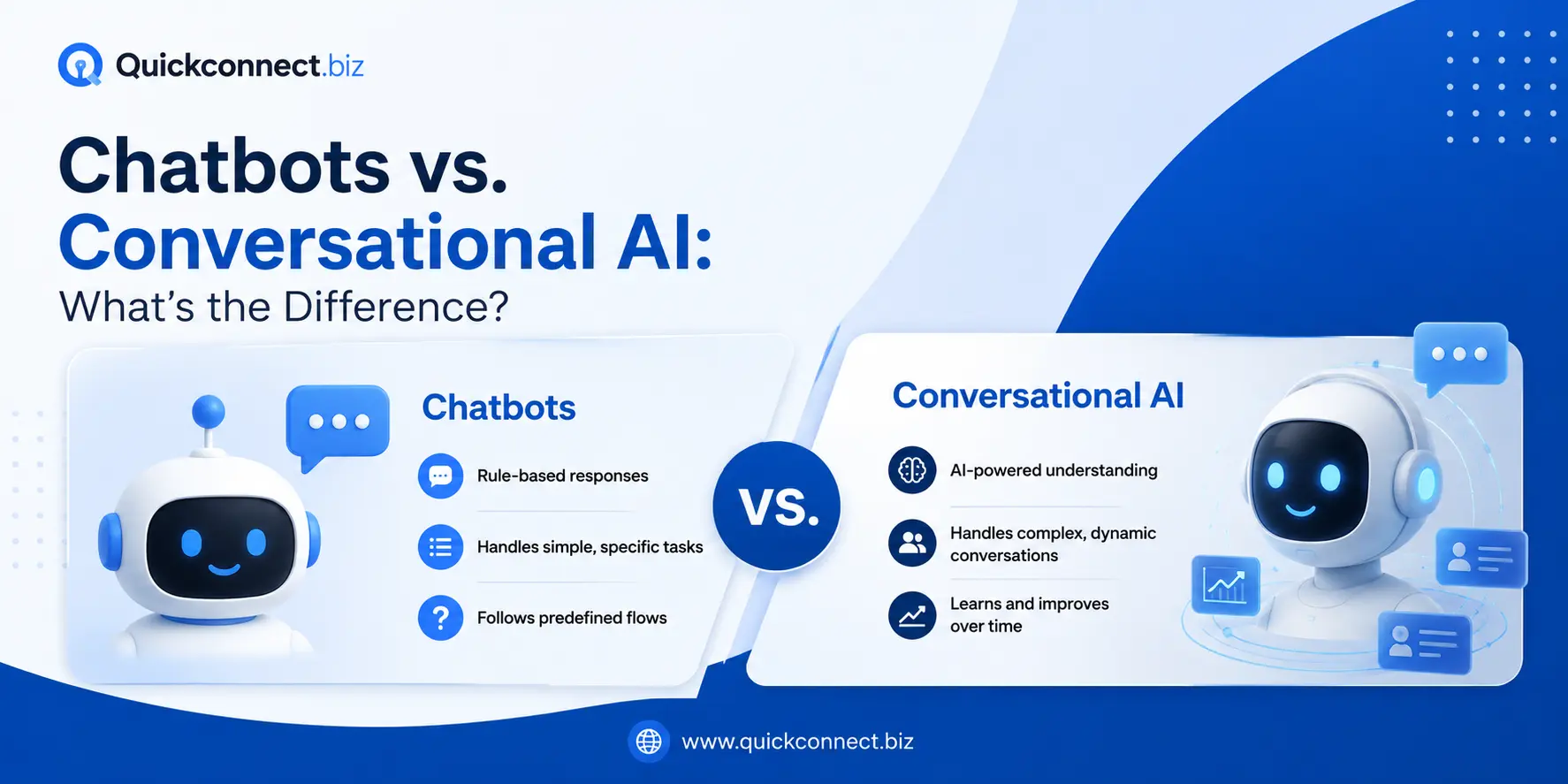
Chatbots are simple bots that answer questions or work on simple tasks. Preset rules or keywords are used in chatbots, whereas conversational AI is more sophisticated and can work with context, have natural conversations, and learn from data.
This article will explore the differences between chatbots and conversational AI, their advantages and disadvantages, and scenarios where they excel.
What is a Chatbot?
Chatbots are bots that can communicate with a person. ELIZA, the first chatbot, was created at MIT in 1966. It mimicked a psychotherapist by rearranging the user’s own words into questions. The vast majority of chatbots deployed in 2015 – 2022 functioned on the principle that is now scaled up: rule-based logic.
They take the form of decision trees, branching if/then flow, where each input by the user is associated with an output.
The working processes of a rule-based chatbot:
- A designer plans all lines of conversation beforehand.
- The bot compares what the user typed with a list of words or buttons.
- If the input contains a trigger word, the bot responds by executing the scripted action.
- The bot will either ask the user to rephrase or direct the user to a human agent if it doesn’t match.
Chatbot is best suited for simple, one-turn interactions like the hours of operation for a store, tracking an order number, or a menu of potions. But when a user says something that the designer didn’t expect, it does happen a lot in practice.
Advantages of Chatbots
Let’s take a look at the benefits of chatbots:
- Immediate responses: Chatbots provide immediate answers to typical queries, cutting down on learner waiting time or customer wait time. They will also be able to recall past interactions for quicker, more efficient support in the future.
- Personalized recommendations: Chatbots can make personalized recommendations, suggest relevant courses or resources, and guide users based on their interests and needs. This will help to make it more customized.
- Availability: Chatbots don’t need to take a break as humans do, so they’re available 24/7. Help is available to users anywhere, anytime, through any communication medium.
- Enhanced lead and opportunity identification: Chatbots can gather data throughout the interactions and determine who might be a potential customer, learner, or opportunity based on inquiries and behavior.
Disadvantages of Chatbots
The disadvantages of chatbots are:
- Rigidness: A lot of chatbots have restricted responses and might not be able to address complex or unusual questions. This can result in incorrect responses or a poor user experience.
- Limited understanding of human emotion: AI Chatbots are not that good at grasping emotion, tone, or context. For sensitive situations, users might want to talk to a real person who can be empathetic and understanding.
- Security and privacy issues: Chatbots may gather and retain user data. To ensure user privacy and trust, organizations must ensure that data handling is secure and transparent.
What Is Conversational AI?
Conversational AI is one of the many technologies that comprise a stack of interrelated technologies that can understand, process, and produce human language in a dynamic way. There are 3 layers to the stack:
NLP (Natural Language Processing): NLP is used to convert raw text or speech into a format that can be processed by a machine. It can process tokenization, part-of-speech tagging, and syntactic parsing.
NLU (Natural Language Understanding): A subset of NLP specifically on meaning. The user’s intention is identified, and entities are extracted by NLU. If a customer types in “I was charged twice for my order last Tuesday,” NLP can break this down into:
- Intent: Billing dispute
- Entities: Charge frequency (twice), time frame (last Tuesday)
NLG (natural language generation): When the system determines what action or response to take, NLG will take the structured output and produce natural-sounding text. An NLG system can respond to the context, not the same response as you would: Your refund has been processed. Your refund will be back on your card in 3-5 business days.
Advantages of Conversational AI
Conversational AI comes with several benefits:
- Personalized learning and support: Conversational AI can recall information from previous interactions, learning history, and user preferences to provide personalized learning and support. This can enable it to offer tailored tips, suggestions, and learning opportunities.
- More natural conversations: Conversational AI can interpret context and converse in a way that is more human. Users can ask questions in natural language and converse more effectively.
- Enhanced learning and engagement: AI can serve as a coach or tutor, maneuvering through scenarios, responding to subsequent questions, and offering live feedback. This keeps students more motivated and helps them retain knowledge.
- Improved Performance and Productivity: By offering personalized guidance and support, conversational AI helps learners develop skills more effectively and apply what they learn in real-world situations.
Disadvantages of Conversational AI
The drawbacks of using a conversational AI are numerous. The disadvantages of conversational AI are:
- More Expensive: Conversational AI is more technologically sophisticated, data-intensive, and training- and maintenance-heavy than traditional chatbots. This may lead to higher implementation and operation expenses.
- Privacy and Security Risks: With the processing of vast amounts of user data a common feature of conversational AI, organizations need to ensure that user information is handled with the utmost security.
- Inaccurate or Biased Responses: Conversational AI can sometimes deliver inaccurate or biased information based on its training data. Monitoring and updating will be required regularly to ensure accurate and fair responses.
- Technical Expertise and Continuous Training: Constructing and sustaining conversational AI systems demands technical skill, regular updates, and enhancements to ensure their effectiveness.
Chatbots vs. Conversational AI: The Key Differences
Here’s the comparison that matters, not just in theory, but in how each technology actually shows up in your learning ecosystem:
| Features | Chatbot | Conversational AI |
| How it works | Decision trees, keyword matching, scripted flows | NLP, NLU, NLG, machine learning, LLMs |
| Flexibility | Rigid. Breaks with unexpected input. | Dynamic. Handles varied phrasing, slang, and typos. |
| Context retention | None. Each message is treated independently. | Maintains context across multiple turns and sessions. |
| Learning | Static. Requires manual updates to add new paths. | Improves from interaction data over time. |
| Complexity handled | Single-turn, predictable queries | Multi-step, open-ended conversations |
| Setup cost | Low. It can be built in hours with no-code tools. | Higher. Requires training data, integration, and tuning. |
| Maintenance | Manual: Every new scenario needs a new rule. | Semi-automated, model retraining, feedback loops. |
| Best for | FAQ pages, simple navigation, lead capture forms | Support resolution, sales qualification, and voice assistants |
Real-World Use Cases: How Businesses Use Each Technology
Let’s explore three of the most common business scenarios and demonstrate how chatbots and conversational AI work differently.
Scenario 1: E-commerce Customer Support
The chatbot method: A customer comes to your online store, raises some questions. The keyword delivery charges are matched, and a table of shipping rates is returned that is predefined. The customer receives a rapid response and is on with their business.
The conversational AI approach: Same customers who appear in your business or WhatsApp, or on Viber, and say, “I ordered a jacket three days ago, but I haven’t heard anything.” The AI fetches the order details, verifies the delivery status, and replies.
The AI can not only find the keywords but also make sense of the context, fetch live data, and respond with a personalized message without engaging a human agent.
Scenario 2: Restaurant/Hotel Reservations
The chatbot approach: If the Guest enquiries if there are any rooms available, the Chatbot determines whether there are any rooms available or not, and returns the result. Guests receive simple information and must book themselves via another platform.
The conversational AI approach: Guests say on Facebook Messenger: “I’m travelling this Saturday with my family. We need two rooms with a mountain view – do you have anything available? The AI verifies access, recommends room availability, and even provides a package deal.
The AI manages the entire booking process in a natural manner and without redirecting the guest to another resource.
Scenario 3: Multichannel Marketing and Lead Qualification
The chatbot method: A visitor clicks a chat widget on your website and asks, “What services do you have?” The chatbot provides a list of services with links to the relevant pages, which is the same list it has on its main page.
The conversational AI approach: A visitor initiates a conversation on Instagram, asking about your services. The AI recognizes their interest with the conversation flow, asks qualifying questions, and segments the lead based on that.
If it then sends a follow-up message to the person through SMS or WhatsApp with a relevant offer, and the conversation history remains linked to the unified inbox. The difference lies in the fact that a chatbot provides information, and conversational AI qualifies leads, personalizes outreach efforts, and helps convert leads across channels.
How to Choose the Right Technology for Your Business
This will depend on your goals, your customers, and your current needs. The following decision framework applies:
Pick a chatbot if:
- The number one thing you need is to minimize support overhead (password resets, schedule lookups, and FAQ deflection).
- The questions that your customers are asking are consistent and repetitive.
- You are not very techy and want a fast win. Your technical resources are limited, and you need a fast win.
- You have a limited budget and must show ROI before scaling up.
If you are looking to invest in Conversational AI, then you should consider:
- You require individualised and context-appropriate interactions with customers.
- You are handling conversations on several media (WhatsApp, Viber, Facebook, Instagram, and on your website)
- You are not just looking to deflect tickets, you are looking to enhance customer satisfaction and retention.
Why not both?
There are many businesses out there that are successful in both of these. The chatbot can take care of the basic, repetitive duties, which involve answering common inquiries and offering quick links, and even collecting leads.
The more complex interactions are handled by conversational AI, which can handle support queries, qualify leads, and interact with customers through various channels with personalized conversations.
The key is to use the right tool for the right job. Avoid using complex AI when a basic chatbot would suffice to solve the problem. Simultaneously, avoid using a simple chatbot when your customers require intelligent advice and immediate assistance.
How QuickConnect Helps You Get the Best of Both
QuickConnect helps you get the best of both worlds: chatbots and conversational AI. You don’t need to sacrifice simplicity for high-dollar enterprise AI with QuickConnect. QuickConnect unites both features into a single platform tailored for businesses.
- AI Bot: Connect your product information, FAQs, and previous interactions to an intelligent AI chatbot that learns and provides accurate, timely answers to customers, round the clock across all channels.
- Unified Inbox: All customer conversations – on WhatsApp, Viber, Facebook Messenger, Instagram, and website live chat, in one place. No more app switching.
- Targeted SMS, Viber & WhatsApp campaigns: Connect with your customers where they are.
- Live chat: Integrate the free live chat widget into your website and turn visitors into customers while they are on the site.
From e-commerce stores to hotels, financial services firms to growing startups, QuickConnect provides the tools to provide faster, smarter, and personalized customer experiences.