Your chatbot communicates with hundreds, if not thousands, of customers each day. But here is the thing most brands miss. If that chatbot sounds like a cold, robotic script, people will close the chat window faster than they opened it.
A chatbot personality is what turns a basic question-and-answer tool into a digital team member that actually sounds like your brand. Most of the people have engaged with a chatbot at least once. Companies with superior chatbot experiences achieve higher customer engagement.
This guide will help you create a perfect brand personality for your chatbot, build a connection with your audience, and ensure that they keep visiting your platform. No fluff. Only steps that will work.
What Is a Chatbot Personality?
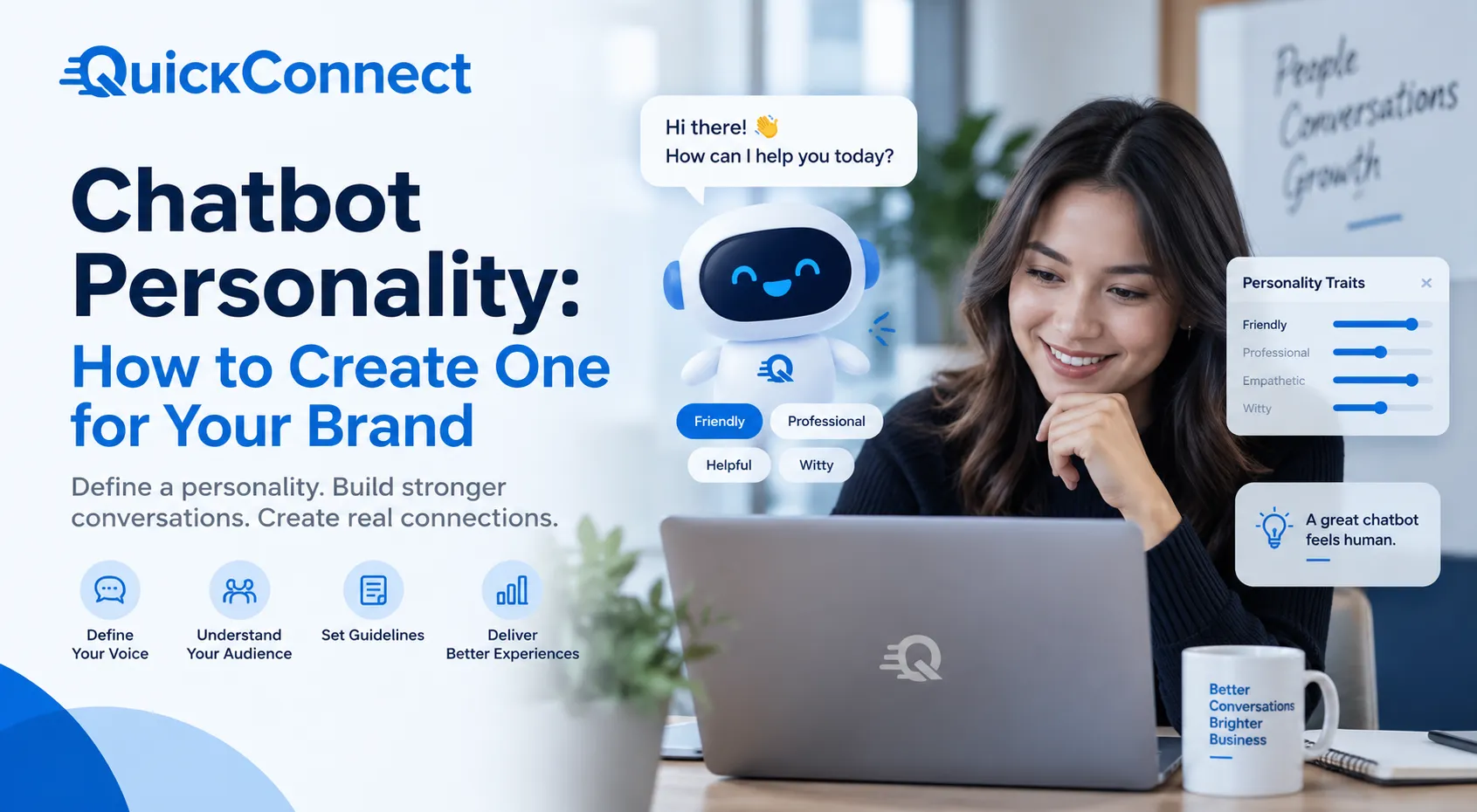
A chatbot personality is the defined combination of tone, voice, language style, and behavioral traits that shape how a conversational AI interacts with users. It reflects a brand’s identity across chat touchpoints to ensure consistent, human-like, and context-appropriate communication.
There are friendly and casual chatbots. Others are business-like and to the point, while some even crack jokes.
The personality includes things like:
- Tone of voice (warm, serious, playful, calm)
- Word choices (formal language vs. everyday words)
- How it greets people (“Hey there!” vs. “Hello, how can I assist you?”)
- How it handles mistakes (“Oops, my bad! Let me try again” vs. “I apologize for the error. Let me correct that.”)
- How it says goodbye (“Catch you later!” vs. “Thank you for reaching out. Have a great day.”)
Every single one of these small choices adds up to create a feeling. And that feeling is what people remember after the conversation ends.
Why Does Chatbot Personality Matter?
While a featureless chatbot can execute basic task responses, lacking a defined personality makes interactions feel cold and transactional. A well-crafted personality establishes brand presence, makes automated conversations welcoming, and improves user retention.
Here is why personality matters more than most brands realize.
1. It Builds Trust and Transparency
Research on AI personality traits and trust shows that human-like qualities such as warmth and agreeableness increase user comfort. Users share information more freely when interactions feel natural, provided the bot maintains transparency about being an AI rather than falsely mimicking a human
2. Maintains Omnichannel Brand Consistency
Brand consistency directly drives customer loyalty across touchpoints. A chatbot with a defined personality prevents tone mismatches—such as transitioning from energetic social media messaging to stiff, robotic chat responses—ensuring a unified brand voice.
3. It Makes Conversations Feel Natural
A natural chatbot personality communicates in natural language, has the correct energy level, and makes the whole interaction smoother. This will extend the time spent on the site and increase the probability of return.
4. It Turns Support Into a Brand Experience
Customer support is often the most common way people interact with your brand. When that interaction has personality, it stops being just support and becomes part of your brand story. People talk about great chatbot experiences; they share screenshots, and they tell friends as well. That is free marketing.
5. It Handles Tough Moments Better
Every chatbot gets confused or makes mistakes. A bot with a helpful personality handles those moments smoothly by saying, “I’m still learning, but let me get a team member to help you out.” This turns a frustrating error into a positive experience that builds trust.
Types of Chatbot Personalities
Before you build your chatbot’s personality, it helps to understand the common types. Think of these as starting points, not strict categories. Most great chatbot personalities borrow from more than one.
The Professional
- Traits: Clear, precise, trustworthy, formal
- Best for: Finance, healthcare, legal, B2B companies
- Example tone: “I’ve found your account details. Your current balance is $2,450. Would you like to proceed with a transfer?”
This personality puts accuracy first. It avoids jokes and small talk. People interacting with their bank or insurance company don’t want a chatbot making puns. They want correct answers delivered clearly.
The Friendly Helper
- Traits: Warm, approachable, helpful, patient
- Best for: Customer service, education, SaaS, retail
- Example tone: “Great question! Let me pull that up for you. Give me just a second.”
This is the most common personality type and for good reason. It works for almost any industry. It feels human without being over the top.
The Playful Entertainer
- Traits: Fun, energetic, creative, personality-driven
- Best for: E-commerce, entertainment, lifestyle brands, food delivery
- Example tone: “Pizza time! What are we craving today? I promise I won’t judge if it’s pineapple.”
This personality takes risks. It uses humor, emojis, and casual language. It works when the product itself is fun or casual. But be careful. This type can fall flat if the customer has a real problem they need solved.
The Expert Guide
- Traits: Knowledgeable, authoritative, clear, educational
- Best for: Tech companies, consulting firms, health and wellness
- Example tone: “Based on your symptoms, here are three possible causes. I’d recommend checking with a healthcare provider for a proper diagnosis.”
This personality positions the chatbot as a trusted advisor. It gives detailed, thoughtful answers and avoids being overly casual. People trust it because it sounds like it knows what it’s talking about.
The Empathetic Listener
- Traits: Caring, reassuring, patient, gentle
- Best for: Mental health apps, healthcare, insurance, HR platforms
- Example tone: “I hear you, and I understand that this situation is stressful. Let’s work through it together, one step at a time.”
This personality shines in sensitive situations. It uses calming language and never rushes the user. The goal is to make people feel heard and supported.
How to Create a Chatbot Personality for Your Brand (Step by Step)
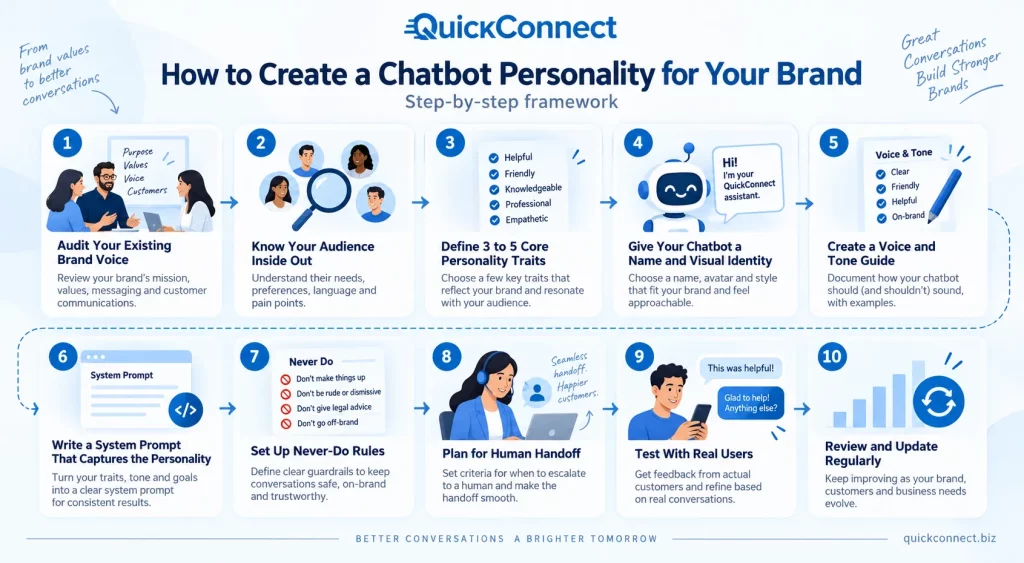
Here is a step-by-step process to build a chatbot personality that actually works for your brand.
Step 1: Audit Your Existing Brand Voice
Before creating a chatbot personality, look at the voice you already use. Your brand already has a distinct style across your website, emails, social media, and customer support. Checking these channels helps you define your core tone so your chatbot matches your existing brand
What to do:
- Gather existing content: Collect sample text from your website, emails, social posts, and customer service tickets.
- Identify key phrases: Make a list of common words and expressions your team frequently uses.
- Determine your tone: Decide whether your current communication style feels formal, casual, or somewhere in the middle.
- Review customer support: See how your team currently handles apologies and resolves customer issues.
You need to build your chatbot in the form of an extension of what is already in place. When your brand voice varies significantly by channel, this step may be useful to help determine what the most authentic voice of your brand is.
Step 2: Know Your Audience Inside Out
The most successful chatbot personalities aren’t necessarily ones you like. It’s the one that your customers are comfortable with.
What to do:
- Identify your audience demographics (age, location, industry)
- Understand their communication style. Do they prefer formal or casual?
- Research their pain points. What do they usually need help with?
- Check how they talk. Look at customer reviews, forum posts, and support tickets
A chatbot for a Gen Z fashion brand should sound very different from one for a corporate accounting firm. The personality needs to match the audience, not just the brand.
Step 3: Define 3 to 5 Core Personality Traits
Pick the traits that will guide every message your chatbot sends. Keep it to 3 to 5 traits. Any more than that and the personality starts to feel scattered.
Example trait sets:
| Brand Type | Traits |
| Online bank | Trustworthy, precise, calm, reassuring |
| Fashion retailer | Trendy, enthusiastic, friendly, helpful |
| Health app | Caring, knowledgeable, patient, supportive |
| SaaS platform | Smart, clear, efficient, approachable |
| Food delivery | Fun, fast, casual, energetic |
Write these traits down. They become your north star for every conversation the chatbot has.
Step 4: Give Your Chatbot a Name and Visual Identity
A name makes the chatbot feel real. It also helps customers remember the experience and talk about it.
Some brands that have done this well:
- Erica (Bank of America) – sounds human, trustworthy, and capable for a banking assistant
- Dom (Domino’s) – short, fun, and pizza-focused. The name matches the brand perfectly
- Lily (Duolingo) – a sarcastic, deadpan character that makes language learning feel less boring
- Maya (Lemonade Insurance) – warm and empathetic, designed to build trust in an industry people usually distrust
Tips for naming:
- Keep it short and easy to say
- Make sure it fits your brand tone (no silly names for serious industries)
- Consider giving it a simple avatar or icon so people know they are chatting with a bot
- Be transparent. Let people know it is an AI, not a real person
Step 5: Create a “Voice and Tone” Guide
This is the document that makes sure your chatbot sounds the same whether you wrote the conversation scripts yourself or someone else on your team did.
What to include:
Vocabulary rules:
- Words to use: (friendly, happy, got it, sure thing)
- Words to avoid: (unfortunately, regret to inform, henceforth)
Sentence structure:
- Keep sentences short. Aim for under 20 words
- Use active voice, not passive voice
- Break long answers into small chunks
Greeting style:
- Example: “Hi there! I’m Mia, your shopping assistant. What are you looking for today?”
Error handling style:
- Instead of: “Error. I cannot process your request.”
- Use: “Hmm, something went wrong on my end. Let me try a different way to help.”
Escalation style:
- Instead of: “This query is beyond my capabilities.”
- Use: “This one is a bit tricky for me. Let me connect you with a team member who can help right away.”
Goodbye style:
- Example: “Glad I could help! Come back anytime.”
Step 6: Write a System Prompt That Captures the Personality
If you are using an AI chatbot, the system prompt is where the personality lives. This is the set of instructions that tells the AI how to behave.
A strong system prompt includes:
- Role definition: “You are Luna, a friendly and knowledgeable customer support assistant for [Brand Name]. You help customers with orders, returns, and product questions.”
- Personality traits: “You are always warm, patient, and clear. You use simple language and avoid jargon. You keep your responses short and easy to read.”
- Tone guidelines: “You sound like a helpful friend, not a corporate script. Use casual but professional language. It is okay to use phrases like ‘Great question!’ or ‘Let me check that for you.'”
- Boundaries: “Never pretend to be human. If asked, clearly state that you are an AI assistant. Never make promises about refund timelines that you cannot confirm. If you don’t know the answer, say so and offer to connect the customer with a human agent.”
- Context-sensitive tone: “If a customer is frustrated, respond with empathy first before offering solutions. If a customer is browsing casually, match their relaxed energy.”
Step 7: Set Up “Never Do” Rules
Knowing what your chatbot should not do is just as important as knowing what it should do.
Common “never do” rules:
- Never use sarcasm when a customer is upset
- Never make up information. If unsure, say so
- Never use more than two emojis in a single message
- Never talk about competitors
- Never give medical, legal, or financial advice without a disclaimer
- Never ignore a customer’s question and redirect to something unrelated
- Never use overly long paragraphs in chat
Write these down and include them in your system prompt and in your team’s documentation.
Step 8: Plan for Human Handoff
No chatbot can handle everything. 55% of consumers still prefer to talk to a human when situations get urgent or stressful. Your chatbot personality should include a smooth, friendly way to pass the conversation to a real person.
- Bad handoff: “Transferring to agent. Please hold.”
- Good handoff: “I want to make sure you get the best help possible. Let me connect you with one of our team members. They’ll be with you in just a moment!”
The handoff should feel like the chatbot is doing the customer a favor, not dumping them.
Step 9: Test With Real Users
Don’t just guess if the personality works. Test it.
How to test:
- Run the chatbot with a small group of users before full launch
- Ask testers to rate how the chatbot made them feel (welcomed, confused, annoyed, helped)
- Review conversation logs for moments where the tone felt off or inconsistent
- Check if the chatbot handled edge cases (errors, offensive messages, off-topic questions) in a way that matched the personality
Pay attention to where people drop off in conversations. That often tells you where the personality broke down.
Step 10: Review and Update Regularly
A chatbot personality is not something you set up once and forget about. Your brand evolves. Your audience changes. New products launch. The chatbot needs to keep up.
What to do:
- Review conversation logs monthly
- Look for patterns in negative feedback
- Update the voice guide as your brand evolves
- Add new response templates for frequently asked questions
- A/B test different tones for specific types of conversations
The brands with the best chatbot personalities treat them like living documents, not finished products.
Real-World Examples of Great Chatbot Personalities
Let’s look at brands that have nailed their chatbot personality and what you can learn from each one.
Duolingo’s Lily
Duolingo did not go so far as to make its AI character generic. Lily is sarcastic, deadpan, introverted, and behaves like a slightly annoyed teenager. She rolls her eyes. She responds to questions with a dry answer. And people love her for it.
Duolingo’s audience is studying languages, which is very similar to homework. Lily’s personality makes it feel like doing a chore with a funny friend. The personality is fitting for a playful, gamified approach to learning that the brand embodies.
Domino’s Dom
Dom is Domino’s voice and text ordering assistant. He has a “one-track mind” for pizza and can tell cheesy jokes. The personality is simple, fun, and 100% on-brand.Ordering pizza should be easy and enjoyable. Dom’s personality removes friction and adds a bit of fun to what could be a boring transaction.
Bank of America’s Erica
Erica is a virtual financial assistant used by millions of Bank of America customers. The personality is calm, clear, and trustworthy. No jokes and no emojis. Just helpful answers delivered with warmth.
People dealing with their money want to feel safe. Erica’s personality creates that sense of security without feeling robotic.
Lemonade’s Maya
Maya handles insurance signups for Lemonade. The personality is warm, empathetic, and designed to make insurance feel less intimidating. Maya guides users through the process step by step, using simple language and a caring tone. Insurance is something people avoid thinking about. Maya’s personality makes it approachable, which is exactly what Lemonade needs to attract younger customers.
Common Mistakes to Avoid
Even with a solid plan, brands make avoidable mistakes with chatbot personality. Here are the biggest ones.
- Trying to Sound Human When You Are Not: 84% of consumers believe human interaction should always remain an option. Trying to hide the fact that your chatbot is AI backfires. People feel deceived when they find out. Be clear about it upfront. You can have personality and still be transparent.
- Picking a Personality That Fits You, Not Your Audience: Founders and marketing teams sometimes pick a chatbot personality based on what they like personally. But the personality should match the audience, not the boardroom. Always test with real users.
- Being Inconsistent: If your chatbot is friendly in greetings but cold when handling complaints, the personality falls apart. Consistency is everything. Write guidelines for every type of interaction, not just the easy ones.
- Going Overboard With Humor: Humor is risky. What is funny to one person is annoying to another. Use humor sparingly and only when the context is right. Never use it when a customer has a genuine problem.
- Ignoring Edge Cases: What happens when someone says something offensive? What about when the chatbot gets five questions in a row that it cannot answer? These edge cases reveal the true personality. Plan for them.
Conclusion
A chatbot without personality is just a tool. A chatbot with the right personality is a brand experience.
The brands winning at this don’t treat chatbot personality as an afterthought. They design it with the same care they put into their logo, their website, and their marketing campaigns.
Every conversation your chatbot has is a chance to build trust, create loyalty, and leave a lasting impression.
Start with your brand voice, know your audience, define clear traits, write a solid voice guide, and test with real people. Your chatbot talks to more customers than any single employee ever will. Make sure it sounds like someone worth talking to.