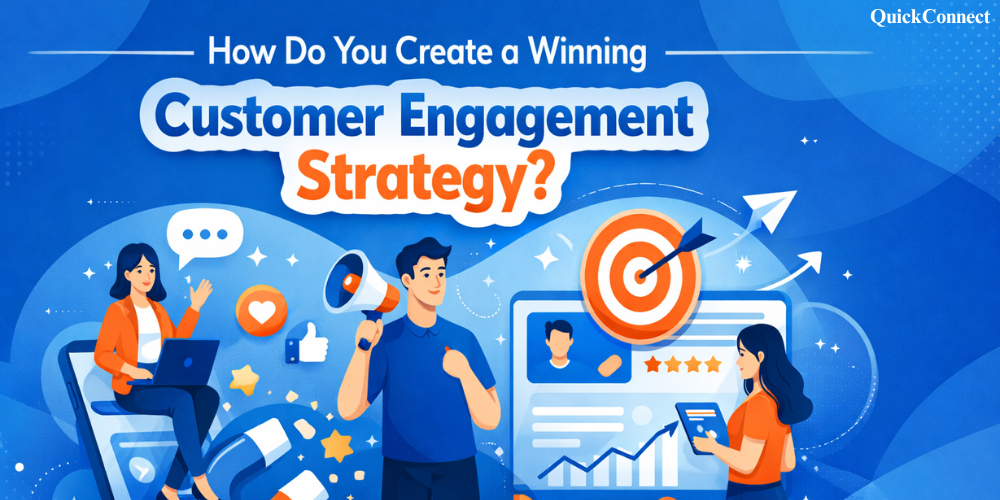
Customer engagement is one of those terms that gets thrown around in boardrooms until it loses all meaning. Everyone agrees they need it, but if you ask five different people what it is, you obtain five different answers.
A winning customer engagement strategy today isn’t about grabbing attention for a second; it’s about holding it for a lifetime. It’s about building an ecosystem so valuable, so helpful, and so human that your customers wouldn’t dream of going anywhere else.
This comprehensive guide helps you to create a winning customer engagement strategy.
What is customer engagement strategy?
A customer engagement strategy is the deliberate, ongoing process of building a deep relationship with your customers at every single stage of their journey, not just when a transaction is occurring.
It moves beyond simple interactions to create an emotional connection, ensuring that every touchpoint, whether it’s a social media post, a support ticket, or an email, delivers genuine value that solves a problem or enhances their experience with your brand.
This strategy acts as the bridge between your product and your user’s success, shifting the focus from short-term customer acquisition to long-term retention and advocacy.
By consistently providing utility and personalized experiences, you transform passive buyers into active partners who not only stay loyal to your business but also champion your products to their own networks.
Why is a Customer Engagement Strategy Important
Customer engagement is not a band-aid or short-term project; it’s key to business success across all sorts of industries–from manufacturing and e-commerce to financial services and enterprise. Whatever the sector, the pay-offs are clear when you place a premium on strong human relationships.
Customers who are engaged buy more, stay around longer, and tell their friends about your brand. It’s as simple as that. No, engagement is showing up, listening, and acting as you care; the outcomes are evidence of this working.
- Improves retention and reduces churn: Your clients (current and potential) need to know you are invested in their success and won’t leave them high-and-dry once they’ve signed on the dotted line. Their livelihood or business, in many instances, may rely upon the continued performance of your product. Bain & Company, for instance, pointed to a manufacturer who was driving engagement across their user journey. These strategies helped them to boost their 35% samples retention rate up to more than 60%.
- Increases conversions and customer lifetime value: Engaged customers are more likely to make repeat purchases and turn into loyal brand advocates. Research demonstrates that methods targeted toward customer delight enable businesses to extract more value from existing customers, with tangible financial gains.
- Generates trust and advocates: Word of mouth is invaluable; nothing establishes trust like presence. Whether you’re hocking a toaster or the latest mobile phone, even a half-million-dollar software solution, customer reviews can often make or break the deal, at least in competitive markets. Advocate stories act as a confirmation of your brand’s promise, and they are far more compelling than any ad you might hope to create.
5 Core Pillars of Customer Engagement Program
A foundation is required for effective tactics. The following pillars are consistent in successful customer engagement strategies:
1. Hyper-Personalization and Context
Standard personalization, like adding a name to an email, is no longer enough. True personalization involves understanding exactly where a customer is in their journey and offering help that matches that specific moment.
It is about relevance, not just recognition. For instance, sending a generic sales email to someone who is currently dealing with a support issue will only frustrate them. Instead, you should detect that they are struggling and send them a helpful tutorial or direct offer of assistance.
2. Omnichannel Consistency
Customers should not be forced to repeat themselves just because they switched from a customer service chatbot to a phone call. An effective strategy ensures that all your teams, sales, support, and marketing have access to the same history and context.
If a customer starts a conversation on social media and finishes it via email, the transition needs to be seamless. They see one brand, not separate departments, and they expect you to remember what they already told you.
3. Balancing AI and Human Support
The most successful companies use automation to handle tasks while reserving their human team for moments that require empathy. Speed is valuable, but it should never come at the cost of genuine understanding.
Use your automated tools for simple jobs like tracking shipments or resetting passwords. However, when a customer is upset or has a complex problem, they should be able to reach a real person immediately. This balance builds trust while maintaining efficiency.
4. Community-Based Growth
Building a space where your customers can interact with each other transforms your brand from a product into a collaborative environment. When users answer each other’s questions and share best practices, they create value that you don’t have to generate yourself.
This approach turns your customer base into a self-sustaining support network. It fosters a sense of belonging that makes it much harder for users to switch to a competitor, as they would be leaving behind their peer group.
5. Engagement-Based Loyalty Programs
Many loyalty programs fail because they only reward spending, which feels transactional. A better approach is to reward the actions that actually deepen the relationship, such as writing a review, referring a friend, or completing a user profile.
By incentivizing these behaviors, you encourage customers to invest their time and effort into your brand. This creates a stronger psychological bond than simple discounts ever could.
How to Create a Customer Engagement Strategy (Step-by-Step)
Having a list of tactics is not a strategy. You need a structured process to build a plan that fits your specific business model.
Follow these five steps to design a framework that delivers long-term results.
Step 1: Understand Your Customers
A successful customer enablement strategy begins with positive emotional understanding and customer connections. You need to know what their buttons are. And it’s not just about online LinkedIn sleuthing or surveys; it’s truly knowing what matters to them the most.
- Speak with your customers: There is no substitute for real conversation. Interviewing customers will allow you to inquire about their demographics, interests, buying habits, and favored content.
- Use customer data to find patterns: Record findings from all those interactions, interviews, surveys, public posts on social media, and research. Also, request customer references and actually follow up on them. Your best data will be quantitative and qualitative customer input. Keep an eye on this feedback and follow it to improve, look for trends or what people prefer, the pain points, and the behavior of customers.
- Use a CRM: A great tool for collecting and tracking customer interactions, a fine CRM system makes everything uniform, personalized, and timely across the whole journey.
Step 2: Personalize Every Interaction
No customer is like another. They may be from different industries, different regions, or have differing requirements even if they are using your product to solve the same problem. Personalization tells them that you understand their challenges and care about their success.
- Segment your audience: Segment customers by industry, maturity, or pain points. For instance, a startup trying to figure out the first processes they need will have different requirements from an enterprise optimizing for scale.
- Customize your messages: In addition to sending messages based on what you’ve already discovered or pre-written templates, use the previous orders to send personal emails, suggest other products according to previous carts, or even upsell. When a brand provides its customers the feeling that it understands them and cares about them personally, this, in turn, makes us more emotionally attached to the brand, causing higher engagement.
- Leverage AI to scale personalization: Use AI bot and automation to help personalize experiences at scale without making them feel automated. Consider two clients assessing a piece of software. One is trying to avoid manual labor, and another is trying to prove out future ROI.” These are two different needs that must be addressed with two levels of messaging and support content. AI can be leveraged to locate these nuances rapidly, search with the appropriate content, and develop the right message. For more information on how AI is driving faster sales efficiency, access The State of Sales Enablement Report 2024.
Step 3: Reach and Convert Customers Across Channels
Today’s consumers want timely and convenient communication in a way that suits them. Some prefer email, others like swift texts, and still others flit around between channels. That being said, it’s crucial that the brand and message stay on-point wherever you communicate.
- Construct an omnichannel program: This could be comprised of email, chat, social media platforms, and even face-to-face meetings. There’s nothing worse than a disjointed experience where you start online, then switch to in-store, or even jump from one site to another, and have to start the process all over again. The best time to engage is when a customer feels you are consistent in every available channel. Ensuring all touchpoints are properly tracked and accessible across teams.
- Leverage digital sales rooms: DSRs offer a central place to house personalized content, webinars, proposals, pricing, and other data for buyers. These online “hubs” enable your prospects to interact with your sales documents on their own schedule.
- Follow your customers: Be where they are. Differentiate your brand wherever your customers and clients do business. For instance, improve your social media presence by posting interesting content and replying quickly. If you’re posting a stat on social media that hardly gets any attention, but it’s a video of a customer success story that garners significant engagement, then you’ve found what your customer base responds to.
- Create a customer loyalty program: Share the love with your customers and offer them something special, such as exclusive offers, perks, or discounts, or even early access to new products. A strong loyalty program can ensure your best customers keep coming back, deepen their relationship with your brand, and give you insight into what they really want. Not to mention, when guests feel appreciated, they are more apt to share and bring even more business.
- Be responsive: Today’s buyers come to the table with expectations of near instant response. If they can have groceries in hours and packages overnight, they’ll expect it from you, no matter what the platform. There may also be DMs on social media from users asking and providing opportunities for a new buyer. Responsiveness is really important, so make sure you watch it!
Step 4: Build a customer-first culture
Customer engagement is not without its processes, planning, and tools, but most of all, it is about the people. A customer-first mentality needs to become part of every single individual who works with customers, even from the point you begin running an effective sales onboarding. That is the only way it can work.
- Break down silos: Collaboration is necessary; teams must talk. It should flow directly to customer success after the sales process ends without skipping a beat. Users don’t want to have to rehash facts already relayed to the AI bot when a human comes on the screen. If it doesn’t seamlessly integrate and just work, don’t use it.
- Enable your teams: Your tech stack should help enable your team to drive conversations using tools like chatbots, live chat, survey tools, social listening platforms, and real-time analytics for insights. Also, take advantage of sales enablement tools, CRM platforms, AI, and content management systems in order to monitor customer information availability of assets and customized experience. The right tools can help you empower your team to improve customer relationships and promote engagement.
- Train and coach consistently: Host in-person and virtual training sessions to inform your team of new messaging, product updates, and sales engagement strategies. In that way, they can change as the customer does and still deliver value in each interaction.
- Make a company commitment: Both leadership and every customer-facing team member should be committed to the idea that every interaction will provide value and drive success. Their success is your success.
Step 5: Measure, Adjust, and Optimize
An effective customer engagement program isn’t stagnant; it changes in response to data, feedback, and performance. Regularly measuring allows you to detect friction points so you can adjust your approach for long-term success.
- Define engagement metrics: There are specific customer engagement metrics that provide a clear view of how customers interact with your brand across all stages of the customer journey. Stay on top of your customer retention rates, net promoter scores (NPS), customer satisfaction (CSAT) conversion rates, and social engagement metrics to gauge what’s working and where you need to make adjustments.
- Collect and apply customer feedback: Gather feedback via surveys, reviews, or direct conversations to learn what can be done better or where there are objections to buying/engaging. Make sure you reply to such feedback by improving and acknowledging.
- Iterate your approach: Based on what you learned, use the information you’ve gathered to modify your approach to keep up with changing customer needs, market trends, and performance gaps. Continuing in that trend will allow you to build smart experiences focused on the customer. For example, if your customer’s average session duration is high, then it is more likely that your customers are finding the content you have engaging. But if the percentage is high, you should check whether there might be barriers or hurdles encountered by your customers. Then, weave these insights into your sales training so that they are flaws you can coach your team on to improve the customer engagement plan.
Final Thoughts: Engagement is the Outcome of Utility
True engagement isn’t something you can hack with a clever subject line or a flashy UI update; it is the natural byproduct of being undeniably useful to your customers.
When you stop trying to “capture” their attention and start trying to earn it by solving their problems and valuing their time, the metrics, retention, loyalty, and revenue will inevitably follow. The brands that win at present won’t be the ones with the loudest marketing, but the ones with the deepest connection.
Start today by picking just one of the strategies above, whether it’s fixing a friction point or sending a personal founder email, and execute it with genuine empathy. The shift from “selling to” customers to “partnering with” them is the only strategy that is truly future-proof.