
24/7 customer support means providing assistance to customers at any time, day or night, through channels like live chat, phone, or email.
Artificial intelligence is transforming customer service, and we’re only seeing the start of this evolution. From intelligent chatbots to enhanced ticket distribution systems, the dominant movement in support currently focuses on leveraging AI to accelerate processes and improve response quality while maintaining personal connections.
With customer demands increasing across platforms such as live chat, email, and social media, organizations require solutions that can both keep pace and evolve continuously.
Research shows that 87% of customers place greater trust in companies that provide outstanding customer experiences (Hyken), demonstrating that the quality of your support is as crucial as your product offerings.
This article outlines key customer service developments and provides actionable strategies to maintain your competitive edge. Continue reading for valuable insights.
What is 24/7 Customer Support?
24/7 support essentially means customers obtain immediate assistance whenever their questions emerge, with companies guaranteeing continuous support availability, 24 hours a day, seven days a week.
Consider this common scenario that many growing businesses face:
Picture a SaaS company serving customers globally. One of the clients in Australia is faced with a malfunction of a project management software at their workplace, and this is the night in the USA when the support team is off duty.
The customer does not have to wait; instead, he/she visit the company site, communicate with a smart chatbot, and browse a vast knowledge base. They manage to find a solution to their problem, and even though there is a time zone difference, their operations do not suffer.
The need for companies to provide 24/7 customer service is becoming increasingly essential as they expand their sphere of influence and enter new markets. This form of assistance is important in establishing good customer relationships and customer experience.
The Advantages of 24/7 Customer Service
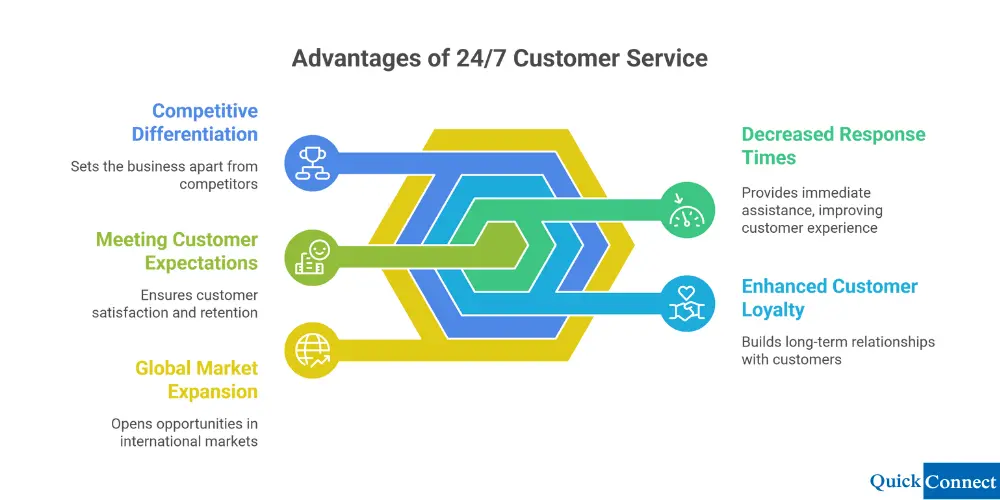
The 24/7 customer support offers many key benefits, upgrading the customer experience and business outcomes:
1. Global Market Expansion
The constant support is beyond geographical boundaries as it caters to customers regardless of the time zone. This inclusivity expands your customer base, promotes international growth, and improves overall customer satisfaction.
2. Enhanced Customer Loyalty
Providing assistance around the clock demonstrates customer commitment. Consequently, customers exhibit increased loyalty, remaining with your brand and becoming advocates.
Thus, this leads to customer loyalty, as they stick to your company and become promoters.
According to research, nearly 80% of consumers worldwide believe that quality customer service is important to them in order to remain loyal.
Most developed platforms enable companies to enhance customer experience by incorporating AI, streamlining the ticket purchasing process, and offering other options, which in turn increases customer satisfaction and loyalty.
3. Decreased Response Times
Timely response and solving of issues will lead to a reduction in waiting time, enhancing the customer experience and ensuring that a small problem does not turn into a complicated issue. This proactive approach will reduce the frustration of the customer and result in better satisfaction.
4. Competitive Differentiation
Continuous support is a definite competitive edge by illustrating customer satisfaction and loyalty that makes you stand out among the others.
Research indicates that 44.5% of the organizations in the world regard customer experience as one of the main competitive differentiators. Moreover, 45% of organizations think the artificial intelligence solutions will reinvent the customer experience in five years.
Although query management and resolution are the problems faced by many companies, query management via AI-based platforms can be automated, and the agents can devote their time to customer relationships.
5. Meeting Customer Expectations
Today’s digitally-focused consumers expect immediate assistance at all hours. Providing continuous support helps meet these expectations, strengthens customer loyalty, decreases customer churn, and enhances your company’s reputation.
Determining Businesses That Need 24/7 Customer Service
The choice of continuous support will be based on several aspects, such as the expenses, the level of technology, the number of personnel available, the level of infrastructure, and, most importantly, the trends of customer inquiries.
There are some industries that are absolutely in need of 24/7 service and agents on call. An example of this need is in the case of IT infrastructure and data centers, where security vulnerabilities or massive financial losses may follow a system crash or downtime.
If you are unsure about implementing 24/7 customer service, we discuss the assessment framework below to help you make an informed decision.
Customer Service 24/7 Evaluation Model
Not all businesses require 24/7 support, but being aware of when you need one can be the key to success or failure in comparison with your competitors. Complete this systematic review tool to identify whether continuous customer service is in line with your business objectives and customer expectations.
1. Business Expansion
- Does your organization boast significant growth in terms of its customer base or market expansion?
- Do you expect more customers to inquire or request services as a result of expanding the business?
- Do you intend to expand your product or services to customers in diverse time zones or geographic locations?
2. Customer Requirements
- Have the customers given feedback or asked to have 24/7 assistance?
- Are your customers across various time zones, which makes it difficult to have access to support during regular business hours?
- Are the customers with ready questions that demand immediate information, or do they have urgent problems that cannot be postponed to the next working day?
- Is your response time above the industry standard?
3. Industry Requirements
- Does your business operate within sectors where continuous support is absolutely critical?
4. Impact Assessment
- Have you considered the operational and financial considerations of having 24/7 support with the integration of the knowledge base and chatbot?
- Are there particular spheres of customer satisfaction and continuous support operations where self-service tools would help to work more effectively?
- Have you considered AI-based chatbots and in-depth knowledge repositories that would be able to augment your 24/7 customer service during off-peak business hours without difficulty?
5. Strategic Alignment
- Based on the above responses, is the continuous support implementation in line with your business goals and customer needs?
- Do you have the readiness to conduct the basic technology and infrastructure investments that are needed to implement the successful 24/7 support?
Finish this evaluation and use these lessons to make practical decisions. If the evaluation indicates a 24/7 support necessity, invest in it to elevate customer service and unlock growth opportunities.
Major technology companies provide continuous customer service to fulfill customer expectations. Amazon, for example, maintains a dedicated support presence that operates continuously across multiple languages.
How To Implement 24/7 Customer Support
Let’s examine proven methods and tools for maintaining continuous customer service, ensuring your business addresses the requirements of a global, constantly connected customer base.
At the industry level, 81% of customers will solve their problems on their own and only call live representatives after that. Nevertheless, according to another survey, 43% of the customers worldwide are not able to find the necessary information by using self-service channels.
Here are the most effective self-service solutions:
1. Knowledge Repository
A knowledge repository is an information management system that is central to gathering, organizing, and structuring data. It contains articles, troubleshooting steps, help guides, demonstrations, frequently asked questions, and other materials in a well-arranged manner.
AI-based systems prove invaluable when it comes to building entire knowledge bases. The sophisticated knowledge management systems are useful in locating recurrent customer queries, integrating online and offline materials, developing step-by-step processes, creating FAQs, etc.
Intuitive navigation and search features enable customers to find the relevant information immediately without inputting support requests and waiting a long time for a response.
2. Conversational AI (Chatbots)
Their customer service can be transformed significantly through AI in the shape of a conversation, where live feedback, short queues, and solving minor issues can be integrated.
The implementation strategy is as follows:
- Installation: Choose a AI chatbot that fits your business needs and insert it into your site or application without any issues.
- Development: AI: Build your AI system to learn and answer frequently asked questions by customers with the help of artificial intelligence and machine learning to constantly refine performance.
- Brand Alignment: Customize AI responses to match your brand voice and communication style, ensuring consistent customer experiences.
- Human Handoff: configure your AI system to permit an easy transition of customers to live support agents in case of those questions that the automated system is not able to answer, and the communication between the customer and the support agent must work as a natural continuum.
In order to develop multi-layered customer support systems, deploy highly advanced conversational AI systems that provide intelligent and context-relevant customer support across multiple touchpoints.
3. Live Support Operations
Even though self-service and AIs may be useful in managing large amounts of work, sometimes direct management by a human is required. One might want to have convenient 24/7 live support, which can be achieved by considering the following:
- Remote Assistance Tools: Establish remote access and screen-sharing technology to offer real-time customer support regardless of their location.
- Constant Agent Presence: The agent should always be there to assist the customers at any given time.
- Issue Prioritization: Have mechanisms for detecting and prioritizing serious customer problems immediately to be addressed.
- Multi-Channel Integration: The support can be offered in several different ways; email, phone, chat, and social media will enable the customers to have multiple ways they contact.
All these conversational AI and live support plans will ensure that you offer a comprehensive and round-the-clock customer care service to the diverse needs of the global customers.
With all these conversational AI and live support strategies, you will provide a full-fledged and round-the-clock customer care service to meet the various global customer needs.
24/7 Customer Support Best Practices
Mediocre and exceptional 24/7 support is differentiated in the details of implementation and constant optimization. These are the best practices that will help you to maximize the effectiveness of 24/7 support operations as well as provide quality and efficiency.
1. Workflow Automation
Automate the processes with AI Chatbots, autonomous replies, and self-service will help to increase efficiency and offer real-time service out of hours.
Example: There is a major e-commerce site with chatbots on the website that can be AI-driven. Customers can ask questions about products, chatbots find answers, search databases of products, and present them in a timely manner, allowing timely, informed decision-making at all times.
2. Trend Prediction
Take AI and predictive analytics, so as to identify trends and behavior of customers. Businesses are also aggressive in problem-solving by examining past statistics and customer habits and providing them with unique solutions.
Example: A software company applies predictive analytics to forecast the needs of the users and trends in the industry. An analysis of the data they do results in the development of a software that is constantly updated with new, important features, thus making the customer experience innovative and smooth, which keeps the customers entertained and happy.
3. Operational Enhancement
Adopt different technology products to enhance efficiency. Some of these are customer relationship management software, Data analytics programs, and project management tools that ensure a smooth communication process and streamlined processes.
Example: A global software development company is utilizing extensive CRM systems to ensure effective customer interaction management, support ticket tracking, product enhancement, and other related tasks. It assists in team-to-team communication to ensure that there is a unified and fluent customer support approach.
4. Self-Service Empowerment
Proper self-service mechanisms, comprising knowledge repositories, interactive tutorials, videos, and chatbots, improve the customer experience as they are able to solve problems independently, troubleshoot, and interact.
Example: A developed e-commerce system implements AI-based chatbots, which analyze customer requests, quickly search databases of products, and provide the information needed, which the customer may use in order to make a wise choice at all times.
5. Cross-Functional Collaboration
Ensure customer experience is improved as a group responsibility. Enhance interdepartmental teamwork, offer customer experience education, establish feedback systems, promote joined-up communications, and bridge gaps by ensuring product enhancements are customer-oriented to seek better experiences.
Example: A product company gets various user queries concerning certain functionality. Although the customer support agent initially addresses these questions, they collaborate with development teams to enhance the feature, thereby eliminating related questions posed by both current and future customers.
Conclusion
Once 24/7 support systems are set, invest in the other most important components: quality assurance and management optimization. The first step would be to know the customers with the help of data analytics, and further formulate strategies and knowledge management systems to support customer satisfaction.
Enhance the customer support infrastructure by utilizing AI-driven solutions, educate teams to respond to queries more efficiently, and incorporate customer-focused thinking to improve products. This approach will lead to a better customer experience and a higher ROI.