Customer service and customer support are often used interchangeably, but they’re not the same thing. Knowing the difference is important to understand because it influences how businesses build teams and how customers experience a brand.
A single bad experience can lose customers. To avoid that, businesses have to be great at both customer support and customer service. The two functions collaborate to provide exceptional customer service.
In this blog, we’ll cover customer support vs customer service, and the primary difference between them.
What is customer service?
Customer service is the act of serving customers throughout their entire journey with a company. It includes providing assistance before, during, and after a purchase. The primary goals are to make this transaction a happy one and develop a relationship with the client.
Essentially, customer service is helping customers feel valued at every stage of the interaction with a product and against the brand.
Customer service involves answering customer queries regarding products/services, helping customers to make the final buy decisions, answering questions regarding bill/account problems, returns/exchanges, faults, and more.
What is customer support?
While customer service is a broader term, customer support is a narrower function within customer service that deals with using a product and resolving specific issues. In most cases, it is a more reactive, technical role. The support team comes into the picture when someone is facing a technical issue or has a query about the existing product they have already started using.
The customer support team identifies and resolves problems so that a product or service functions as designed.
Support agents help with troubleshooting errors, guiding customers through technical, step-by-step processes, suggesting how to use the product, or managing repairs or software bugs. These are typically post-purchase (once the customer is having a problem) and are administrative interactions.
While almost every company offers some level of customer service, not every company needs a dedicated customer support team.
Key differences between customer support vs customer support
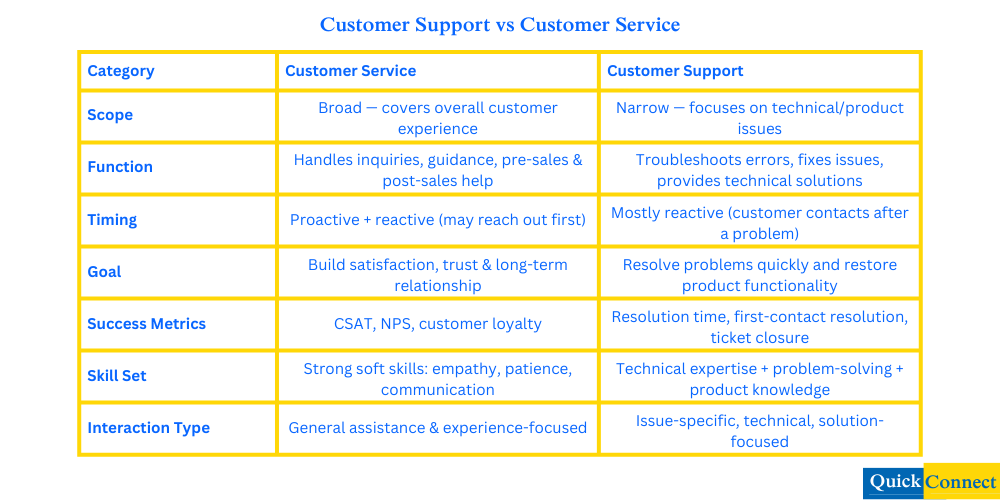
Both customer service and customer support aim to keep customers happy, but they differ in scope and approach. Let’s break down the key differences between customer service and customer support on the basis of function, timing, goals, and required skill sets for each role.
1. Function and Scope
Customer service: Broad scope, dealing with the overall customer experience. Customer service reps manage all types of customer requests, from responding to pre-sales queries and offering post-sale follow-ups. They ensure the customer has a successful end-to-end journey with the company. These can be questions, lack of knowledge or ideas, how things work, confirmation on something, etc.
Customer support: Narrower scope, focused on specific issues and technical problems. Customer support teams come to the rescue when a user gets stuck using a product or service. Their job, in a word, is to troubleshoot, that is, to help users identify and solve problems (such as installing software or debugging an error) rather than just providing use-case education.
2. Timing and approach
Customer service: Sometimes proactive as well as reactive. Customer support is the whole process from the customer’s first visit to a company till the end. Service reps can meet customers at the very beginning (such as welcoming them in a store or answering live chat questions on a website), through checkout, and even after helping with issues post-purchase. They don’t just wait to hear if something goes wrong; they call and ask if help is needed, and try to anticipate needs or problems.
Customer Support: Primarily reactive. Support comes into play when a customer contacts with a problem. This is usually after the customer has a problem. They purchased a product or service and now need assistance resolving something. Customer support doesn’t usually initiate contact unless responding to an issue or following up on a support ticket.
3. Goals and metrics
Customer service: The main objective of customer service is to create a positive overall experience and develop rapport with customers over the long term. From keeping the customer satisfied to creating a loyal customer base and even repeat business or referrals. For a customer service team, their hope is that every interaction makes a customer feel positively about the company. That means their typical success metrics for customer service are proxies for customer satisfaction and loyalty, net promoter score to measure how happy customers are, and whether they would recommend the company.
Customer support: The focus of customer support is to quickly resolve the customer’s problem and restore the product/service to proper function. The emphasis is on solving the problem fast and efficiently. That is the reason support teams are usually measured on efficiency and resolution-based metrics.
4. Required skill sets
Customer Service Skills: Working in customer service requires great communication and interpersonal skills. These roles involve a large amount of private interaction across all sorts of different situations and places. Important skills to have in such a role include empathy, patience, and active listening, clear communication of any kind, and the ability to think through problems without delay. Customer service representatives need to remain cheerful and helpful even when dealing with an angry client. They also need to adapt their approach according to different temperaments. They should also have the knowledge to answer questions about the company’s products and policy, but a more important focus is on soft skills
Customer support skills: Customer support staff also need empathy and communication skills, because they are dealing with customers day in and day out. But support staff typically are the product or service experts. They need to snap-fix problems, usually from a technical point of view or by cross-referencing with a help desk handbook, guide, or other piece of material.
Examples to Illustrate the difference
Understanding abstract definitions is easier with examples. Below are two scenarios that show customer service vs. customer support in action, one in a retail context and one in a software context.
Example: Customer service in retail
Imagine you walk into an electronics store looking for a new camera. A store associate greets you with a smile and asks what you’re looking for. You explain your needs (for example, a camera for casual family photos vs. professional photography). The associate listens and then provides recommendations on which camera might suit you best. They answer your questions about different models, compare features, and even offer some tips for using the camera you choose. Once you decide, they might suggest a suitable memory card or bag (upselling only if it adds value for you).
This is customer service in action. The employee helped you before the purchase (guiding your choice), during the purchase (making checkout smooth, answering questions), and even set you up for after the purchase success (with tips/resources).
Example: Customer support in software
Now let’s say you did buy that new camera, and a week later you encounter a problem: the camera’s firmware isn’t updating properly, and you’re getting error codes you don’t understand. You go to the camera manufacturer’s website and start a live chat, or call their helpline. The person who responds is a customer support specialist. They ask for details about the error message and your camera model. They might walk you through a series of troubleshooting steps: for example, downloading a firmware file, resetting the device, or checking a setting on the camera. If the issue is complex, they might escalate it to a technical team or schedule a repair.
These situations are customer support. The interaction is initiated because something isn’t working as expected (a technical problem). The support representative’s role is to get you back on track with the product.
The contrast: In the retail customer service example, the employee was concerned with your overall satisfaction and success as a customer (no immediate problem needed to prompt the interaction). In the software support example, the agent was laser-focused on solving a specific problem you had with the product. Both roles are vital – one ensures you feel good about being a customer, and the other ensures you can actually use what you bought successfully.
Why the distinction matters (for businesses and customers)
Understanding the difference between customer service and customer support is more than a semantic exercise; it has real implications for how a business operates and how customers perceive their experience.
For businesses: Knowing the distinction helps in staffing the right people in the right roles, setting the right strategies, and allocating resources effectively. For instance, if a company knows that customer support deals with technical fixes, they will hire support agents with the necessary technical expertise. Those agents can focus on troubleshooting without also being tasked with sales or general inquiries. Meanwhile, customer service teams can concentrate on customer relations, feedback, and guidance. This specialization can improve efficiency and customer satisfaction.
For customers: The benefit is receiving quicker and more effective help. When you contact a company, you get routed to someone who can truly assist with your need. If it’s a how-to or general question, you get a friendly customer service rep who has the answers. If it’s a technical glitch, you get a knowledgeable support agent who can fix it. This means less runaround and a smoother experience. From a customer’s perspective, they might not care what the team is called; they just want their issue resolved or their question answered.
When a business needs both customer service and customer support
Most successful companies realize that it’s not customer support vs customer service, but customer service and customer support. The two functions are complementary partners in delivering a great customer experience. So when do you need both, and how should you set them up?
If your business involves any kind of product or service that can malfunction, confuse the customer, or require technical knowledge to use, you need a customer support function in addition to general service. Nearly all businesses need customer service in some form (to handle sales, inquiries, and general customer care). But customer support is especially needed in industries like tech, software, electronics, appliances, SaaS, and telecommunications, where customers will have how-to questions, technical difficulties, or bugs.
How to structure them effectively: The structure often depends on the size of the business. In a small business or startup, it’s common for the same team or even the same person to wear both hats, one day handling general customer emails, the next day fixing a technical problem for a user. This can work when volume is low, but as the company grows, splitting the roles is usually wise. A larger company should create a dedicated customer service and a dedicated customer support team (or department).
Conclusion
Customer service and customer support are two sides of the customer experience coin. Customer service is about building relationships and providing a great experience throughout the customer’s journey, while customer support is about providing targeted help to resolve issues. Businesses shouldn’t choose one over the other; most will find they need both to truly satisfy customers.